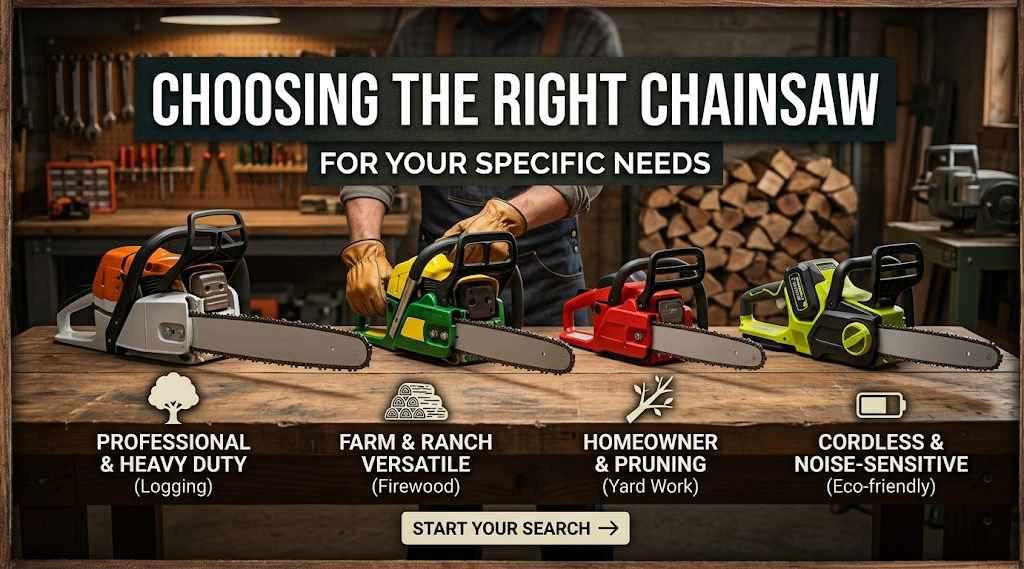
You will have to look into lots of things for the best chainsaw you want for your tasks. You might want to use it in your lawn or in a forest, and there are different sizes for each use. That means you will need to read a guide to choose the right chainsaw for your needs. Here it is, and you will get every answer in it.
You should know about chainsaw’s application, wood type, power limit, and bar length. Also, its usage frequency, size of project, certifications, and safety features are part of the inquiry. Besides, you will have to ensure that the parts replacement and maintenance are user-friendly. Chainsaws are of two main types: professional ones and homeowner ones.
If you make a mistake in it, the results will be inaccurate. The bar size, chain length, and engine/motor power differences change the results. Choosing the wrong size will also cause overheating or excess wear and tear in the machine. It could be vice versa, where the machine might take lots of energy for a simple task.
There are three types of chainsaws, but one is the most common in the world. Their performances are different because of their operating conditions, upfront costs, and maintenance costs.
Besides, they are ideal for wood cutting in residential and commercial operations. Homeowners, forestry professionals, carpenters, and rescue professionals use them often. Chainsaws can work efficiently on all types of wood, whether it is softwood, hardwood, dry, wet, or even frozen wood. You can cut hardwoods like maple, walnut, oak, teak, and hickory types easily. Also, you can cut softwood like redwood, pine, spruce, and cedar with a chainsaw.
Besides, some people use them for plastic, aluminum, and even ice cutting. However, it is better and safer to use them only on wood.
A residential chainsaw is for pruning in the lawn and backyard, and also for cutting firewood. On the other hand, a professional chainsaw is for heavy cutting of logs in forestry work. Residential ones are slightly lighter because of less powerful components in them.
It is just not about good chainsaw teeth; it is about the compatible power of the engine/motor. If you choose a chainsaw with incompatible cc for your task, the results will be unsatisfactory. Even if the chainsaw is of a top brand, the incompatibility will ruin all the efforts and investment. Here is what you should do.
For heavy-duty work, the construction material matters as much as the CCs, see our complete guide to professional gasoline chainsaws for the difference between magnesium pro saws and plastic consumer models.
The bar length makes the difference in application, and this is what you should select carefully. If you are looking for residential use, there will be a shorter length. For commercial use, there will be a larger length.
If you want to do pruning in the garden, lawn, and backyard, choose between a 12 and 14-inch bar length. It will be ideal for light tasks like pruning and firewood cutting.
To deal with medium trees in your lawn or park, choose between a 16 and 18-inch bar length. This length will be compatible with such works.
If you are a professional who has to deal with large trees, choose over 18-inch bar length. Any size above it will be ideal for logging and mega cutting.
There will be incompatibility and a lack of power because the motor will not support it. Even if you install it, there will be issues like excess pressure on the motor/engine.
A 20-inch chainsaw can cut between 18 inches and 32 inches of a tree’s diameter.
Choose an 18-inch chainsaw for more penetration and medium-level work. If you prune or cut firewood, a 16-inch chainsaw is better.
An ideal size ranges between a 12-inch and an 18-inch chainsaw for home use.
Then you need to consider secondary factors also. It is not just about the cutting power, but more than that. You will have to consider the comfort, safety, and durability level of the chainsaw. Besides, there are some other factors to know.
Gasoline and battery-powered chainsaws are portable, but a gasoline chainsaw is more reliable for long tasks. Battery-powered chainsaws require frequent charging when it comes to long operations. Corded chainsaws are always dependent on a power supply, which makes them less reliable. Chainsaws for home use are slightly lower in weight, but all types are ergonomic.
There must be a rear hand guard, chain break, safety throttle, stop switch, and chain catcher. Also, there must be a throttle trigger lockout and an easily accessible on/off switch near the main hand. The rubber on the handles must be thick enough to make a strong grip.
If the chainsaw causes excessive vibration, there will be lots of problems for the operator. So, the chainsaw you are choosing must have an anti-vibration system for stable use.
Besides grip, the design must be aligned with the hand position. There must not be pain or fatigue after some minutes of holding the chainsaw. It includes the type of plastic and rubber, which must be skin-friendly.
The price may vary depending on the brand and features. Jiangsu Tailin Power Machine Co., Ltd. is one of the suppliers that can offer a very affordable price range. What you need to do is explore the market on different platforms for a suitable price and features.
The operating cost can make lots of difference. If it is frequent and high, this issue will be problematic. So, what you need to do is choose a chainsaw that requires less maintenance and gives higher performance.
The durability and lifespan is the return of your investment. So, a chainsaw with high performance, along with durability, is the best investment. You can find such chainsaws on Jiangsu Tailin Power Machine Co., Ltd. Besides, you can try online B2B/B2C platforms for more options.
These two elements are mandatory, especially in machines. Chainsaws from Jiangsu Tailin Power Machine Co., Ltd. can offer success in both. There are many brands available in the market, and you can explore them. However, the features must be high if there is warranty coverage and brand reliability.
Before you finalize the decision, make sure the chainsaws are safety-compliant. For instance, Jiangsu Tailin Power Machine Co., Ltd. offers reliable and safety-compliant chainsaws. Even if you are choosing a different brand, make sure the manufacturer complies with safety standards. ANSI B175.1-2021, CSA Z62.1-15 (R2024), EN ISO 11393, and ISO 11681 are common for forestry machines like chainsaws.
You need to explore the primary and secondary features of a chainsaw when you want to buy one or in bulk. There are lots of factors like power limit, cutting bar’s length, teeth’s size, and material compatibility. Their weight, ergonomics, certifications, designs, and comfort factors are also included. So, you can find all these features in a compatible and affordable form at Jiangsu Tailin Power Machine Co., Ltd. You can inquire with us for more details.
Choose between 12-inch and 18-inch chainsaws for garden, lawn, etc.
Yes, especially for heavy-duty performance, long-hours operation, and portability.
12-inch to 14-inch chainsaws are suitable for small trees. You can do pruning and firewood cutting with it. 16-inch to 18-inch chainsaws are good for medium trees. While any chainsaw with an over 20-inch cutting size is the best for large trees.
Do not try a chainsaw on metal, concrete, rubber, sand, stones, mud, or glass. Also, avoid cutting anything that is above your shoulder height, as there may be possible accidents. Do not cut trees near electric wiring.
Keep the blade clean after every use. Clean the spark plug if there are power issues or backfires in the gasoline chainsaws. Check the oil in the tank to prevent low levels. Inspect the air filter if the engine is not having much power. Replace the chain if you find excess wear and tear on it or poor cutting results. You can apply rust preventive spray on the chain and bar.
Loss of power, hard starting, excessive noise, smoke, and excessive vibration are some signs of faulty chainsaw.
When you notice damaged teeth, uneven teeth, poor cutting, and excessive wear on the cutting chain, replace it. If there is a worn wear marker, you can inspect the line on it to analyze the condition.
You will have to look into lots of things for the best chainsaw you ...
READ FULLBattery technology might have improved over the years in chainsaws, ...
READ FULL