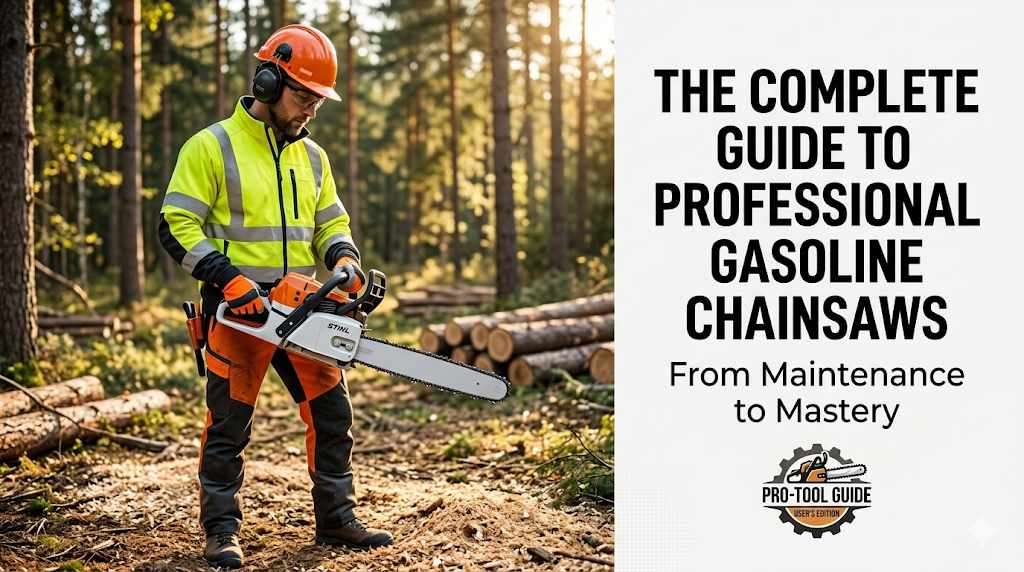
Battery technology might have improved over the years in chainsaws, but visit any commercial logging site or fire rescue staging area. What do you hear? The snap of a two-stroke engine. Gasoline chainsaws still dominate and remain the undisputed king for industrial forestry. Why? Power-to-weight ratio. Runtime. Reliability when you are forty miles from the nearest electric socket in the middle of nature.
Electric saws have their niche. But that niche is not suited for raw outdoors work. In the professional landscape, only the equipment that survives abuse, dust, and continuous high load can excel and remain as the top choice among seasoned cutting professionals.
In this blog, we will dissect the Tailin professional lineup models H353, H365, H372, and H450, but more importantly, we will teach you how to think like a master mechanic. You need to match metallurgy to timber. One wrong bar length costs you a day. One dull chain costs you a shoulder. Let’s cut to it.
Here, the spec that matters is displacement, measured in cubic centimeters (CC). This is your raw horsepower promise. But do not chase CC blindly, that is a mistake many rookies make. A higher CC saw that weighs three more pounds will fatigue your forearms faster than a balanced 50cc model.
The guide bar assembly is your lever. Sprocket nose bars are for speed and reduced friction. Hard-nose bars are for abrasive, dirty wood, coming in handy in work tasks like demolition or stump work. For general forestry, always choose sprocket nose. Bar length should be adjusted for the task: fourteen to sixteen inches for pruning. Twenty to twenty-four for felling medium timber. Twenty-eight inches plus? You are in Pacific Northwest territory.
Chain mechanism is where mid tier or low standard chainsaw moldes struggle in the efficiency department. A professional chain has three critical parts: the cutter tooth (shape determines aggression), the depth gauge (controls bite depth), and the tie strap (holds it together). Most operators accustomed to working with low-end models sharpen the tooth but ignore the depth gauge. That is a mistake. A gauge set too high stalls the engine. And if the opposite is true, the saw has a lot of recoil and encounters resistance.
High-performance gasoline two-stroke engines require a fuel mix at precise ratios. That means 50:1 for modern units. If you are using stale fuel, then that means an open invitation to varnish in the carburetor. Skip quality bar oil? You weld the chain to the bar.
A gasoline chainsaw is a versatile tool that can adapt to diverse jobs.
Industrial forestry requires chainsaws capable of high-capacity logging. In these projects, the chainsaw runs for ten hours. Downtime means lost revenue. The best fit here is a chainsaw variant that delivers torque at low RPM.
Arboriculture is the opposite. Precision climbing saws must be light and rear-handled or top-handled for single-handed use. Here, superb balance matters more than raw power.
These activities use saws for ventilation and roof cutting. These saws must start cold on the first pull. No excuses. Chains are often carbide-tipped to cut through nails and shingles.
Property management is a task involving large-scale land clearing, so here durability is preferred, and chainsaws should be low maintenance and durable.
Here is the market distinction you rarely hear. Professional-grade saws use magnesium crankcases. Consumer DIY models use plastic clamshells. Magnesium dissipates heat. Plastic melts under sustained load. That is the difference between a tool that lasts one season and one that lasts fifteen years.
It is easy to get confused between different metrics. Power-to-weight ratio is the only number worth memorizing. A saw that pulls 4.2 horsepower but weighs fifteen pounds will wear you out by noon. A saw with 3.8 horsepower at twelve pounds? You will be breezing through the tasks.
Chain speed is another metric that matters for softwoods. Torque matters for hardwoods like oak or hickory. High chain speed without torque just makes noise and heat. Look for max torque at lower RPM that is the engine working smart, not hard.
Ergonomics are not just features for aesthetic and stylish appeal. They have a purpose. Handle geometry affects your wrist angle during a bore cut. A poorly balanced saw forces you to fight gravity. A good saw becomes an extension of your arm. Another ergonomic feature is an anti-vibration system that reduces strain on the nerves during handling.
|
Rank |
Model |
Power-to-Weight (hp/kg) |
Best For |
Key Weakness |
|
1 |
Husqvarna 572XP |
0.92 |
Professional felling |
High purchase price |
|
2 |
Stihl MS 500i |
0.96 |
Injection response |
Electronic complexity |
|
3 |
Tailin H372 |
0.89 |
Hardwood/Value |
Limited dealer density |
|
4 |
Echo CS-7310P |
0.87 |
Western softwoods |
Vibration damping |
|
5 |
Tailin H450 |
0.78 |
Milling/Large dia. |
Heavy for climbing |
|
6 |
Makita EA7900P |
0.85 |
Long bar applications |
Discontinued support risk |
|
7 |
Tailin H365 |
0.82 |
Fire/Rescue |
Fuel tank capacity |
|
8 |
Jonsered 2260 |
0.84 |
Thinning |
Parts availability |
|
9 |
Dolmar PS-7910 |
0.83 |
Power for price |
No dealer network |
|
10 |
Tailin H353 |
0.88 |
Arboriculture |
Chain brake lever feel |
Tailin holds three spots in the top ten. That is not luck. That is value engineering without sacrificing magnesium chassis or professional seals.
For a seasoned cutting professional these features are non-negotiable.
Chain brakes must engage within a fraction of a second. Hand guards ar crucial for that solid grip of left hand to prevent it from sliding into the cut zone. Throttle locks prevent accidental acceleration. If a saw lacks any of these, refuse it.
Best practices of handling chainsaws are to be remembered at all times. One is to never drop-start a saw. Engage the chain brake before moving more than ten feet. Secondly, do not cut with the bar tip unless you have trained for a bore cut. Most kickback accidents happen not during felling, but during the two seconds of complacency between cuts.
PPE requirements are your guranteed protection against accidental risks so skipping them is a grave mistake. If you are a professional cutter act like one and get the full protective gear of helmet with face screen, chainsaw chaps with Kevlar, gloves with high-friction palms. And finally hearing protection rated for over 100 decibels.
A sharp chain is a safe chain. A dull chain creates heat, dust, and is frustrating to work with.
Daily-clean the air filter, check chain tension, inspect bar rails.
Weekly-remove the clutch cover, clean accumulated pitch, sharpen chain to factory angles.
Monthly-check sprocket tip wear, replace fuel filter, clean the muffler spark arrestor.
Use a round file matched to chain pitch.
File from the inside of the tooth outward. Two to three strokes per tooth. Keep equal pressure.
Then file down the depth gauge every third sharpening. Test by cutting a softwood branch, you want six-inch chips, not sawdust.
|
Symptom |
Likely Cause |
Immediate Fix |
Strategic Prevention |
|
Engine starts but dies under load |
Clogged fuel filter or lean carburetor setting |
Replace fuel filter. Adjust carburetor high-speed screw one-eighth turn richer. |
Use fresh premium fuel. Change filter every fifty hours. |
|
Chain spins at idle |
Clutch springs stretched or broken |
Replace clutch springs as a set. Do not run the saw until fixed. |
Avoid prolonged idling. Replace springs every two seasons. |
|
Bar burns wood instead of cutting |
Oil port clogged with compacted sawdust |
Remove bar. Clean oil port with wire or compressed air. |
Use high-quality bar oil. Clean bar groove every tank refill. |
|
Chain cuts crooked or drifts |
One side of cutters duller than the other |
File both sides equally. Count strokes per tooth. |
Total cost of ownership is the only honest metric. A cheap saw at three hundred dollars that lasts two years costs you one hundred fifty per year. A Tailin H372 at six hundred dollars that lasts ten years costs sixty per year. Plus you keep your sanity.
Warranty length (two years commercial minimum). Parts availability within your region. Service interval convenience can you change a fuel line without splitting the case? If not, walk away.
For bulk procurement or specific model inquiries, contact Tailin directly through their commercial channel. Request the 2026 fleet pricing guide. Ask about spare parts kits bundled with orders of five units or more. Off-rhythm sentence: Do not buy a saw online without touching its handle first. Seriously.
The best saw in the world is useless if you store it with old fuel. Empty the tank before winter. Run it dry. Pull the cord once to clear the carburetor. Then, and only then, put it on the shelf.
You will have to look into lots of things for the best chainsaw you ...
READ FULLBattery technology might have improved over the years in chainsaws, ...
READ FULL